
Production — Ø219–Ø4064 mm
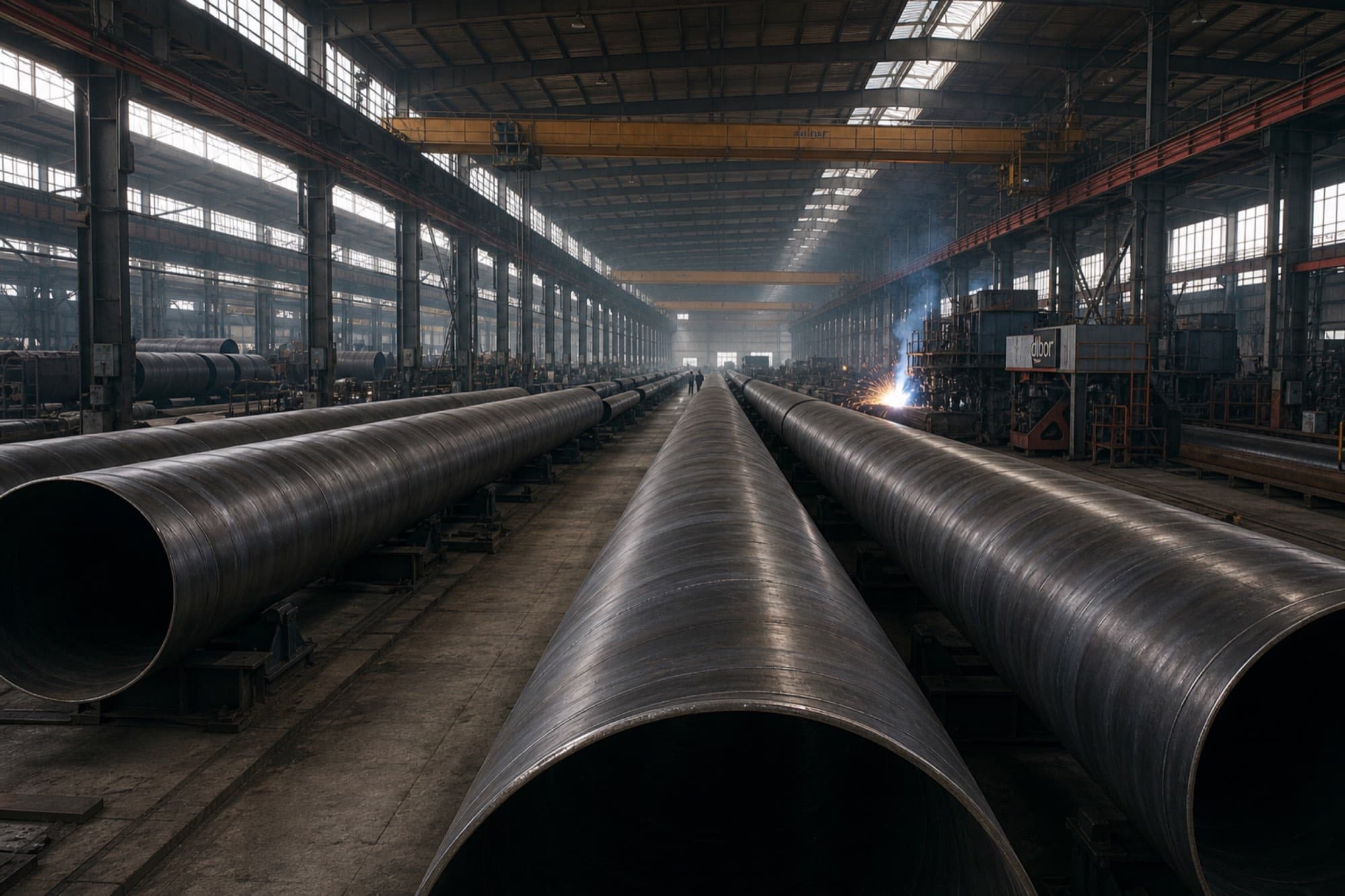
Spiral Welded Steel Pipe
Flat steel coil is formed into a spiral; the strip edges are joined by internal and external submerged arc welding (SAW). Used across a wide range of applications, from water, waste water, oil and natural gas lines to foundation piles.
Applications
Where does it work?
- Water transmission lines
- Oil pipelines
- Natural gas distribution lines
- Foundation piles
- Industrial piping systems
- Steel structural systems
- Compressed air lines
- Drilling wells
- High-temperature water transport
- Shipyard and harbour piles
Key Properties
Why spiral welding?
- High strength
- Resistance to pressure and impact
- High carrying capacity
- Long service life and operational continuity
- Structural flexibility
- Easy installation
- Forming and machinability advantages
Standards
Technical standards and regulatory compliance
European standard defining technical delivery conditions for welded alloy and fine-grain steel tubes used in pressure applications.
International standard defining technical delivery conditions for steel pipes used in pipeline transportation systems in the petroleum and natural gas industries.
European standard defining technical delivery conditions for welded steel tubes for pressure purposes.
European standard defining technical delivery conditions for welded steel tubes of circular cross-section for the conveyance of water and other aqueous liquids.
European standard defining general technical delivery conditions for cold-formed welded structural hollow sections.
European standard covering conformity assessment and CE marking for the fabrication and assembly of steel and aluminium structural components.
International standard defining comprehensive quality requirements for fusion welding of metallic materials.
European directive setting out the rules for the conformity assessment of pressure equipment above a specified pressure level.
Production Process
Eleven steps from coil to dispatch
Raw Material Inspection
Hot rolled steel coils undergo dimensional, mechanical and chemical testing. Approved material is labelled and moved to the stockyard.
Coil Slitting and Edge Preparation
Steel coils are slit to the width required by the pipe diameter; strip edges are milled to obtain a clean welding surface.
Spiral Forming and Welding
The prepared strip is formed into a spiral at the required diameter. Inner and outer seams are joined by submerged arc welding (SAW).
Online Ultrasonic Inspection
During production, the weld seam and surface are monitored in real time with ultrasonic equipment.
Cutting to Length
Spiral welded pipes are cut to the length required by the project and the applicable standards.
Bevelling
Pipe ends are bevelled to standard to ensure high-quality field welds.
Hydrostatic Testing
Each pipe is pressure tested with water at the specified values to verify resistance to operating pressure.
Radiographic (X-Ray) Testing
Weld seams are examined radioscopically in detail according to customer requirements and applicable standards.
3LPE External Coating
Where specified, the outer surface is blasted to Sa 2½ and coated with fusion-bonded epoxy, copolymer adhesive and extruded polyethylene. The entire surface is scanned with a high-voltage holiday detector.
Liquid Epoxy Internal Lining
For potable water and transmission lines, the pipe bore is lined with liquid-applied epoxy to TS EN 10339. Dry film thickness is measured at multiple points and reported.
Final Inspection and Dispatch
Completed pipes pass final inspection, are marked and dispatched to the stockyard under a barcode tracking system.
FAQ
Frequently asked questions
What diameter range do you produce?
We manufacture spiral welded steel pipe from Ø219.1 mm up to Ø4064.0 mm in more than 40 diameters, with wall thicknesses from 3.0 to 25.4 mm. Intermediate sizes can be produced on request.
Which standards do you produce to?
We hold certificates for EN 10217-1 and EN 10217-3 (pressure applications), EN 10224 (water transmission), EN ISO 3183 (oil and gas pipelines), TS 5139 and EN 10219. Every shipment is delivered with an EN 10204 3.1 inspection certificate.
What is the difference between spiral and longitudinally welded pipe?
Spiral welded pipe is formed from coil with a helical weld seam, which makes large diameters (especially above Ø500 mm) economical and offers wide size flexibility. It is the standard worldwide solution for water transmission, piling and energy projects.
Do you supply pipe for drinking water lines?
Yes. Our pipes produced to EN 10224, combined with potable-water-approved liquid epoxy internal lining certified to TS EN 10339, are safely used in drinking water transmission lines.
Do you manufacture piling pipe?
Yes. We produce piling pipe in the requested diameter, wall thickness and length for foundation engineering, jetty, port and deep excavation projects.
Which coating options do you offer?
Externally: three-layer polyethylene (3LPE — DIN 30670, TS EN ISO 21809-1) and liquid epoxy (EN 10289). Internally: potable-water-approved liquid epoxy (TS EN 10339). Bare (black) delivery is also available.
How do I request a quotation?
Send diameter, wall thickness, steel grade, standard, coating type and quantity via the contact form, to sales at dibor.com.tr, or by phone. Quotations are typically answered within 1–2 business days.
What are your delivery times?
Lead time depends on order tonnage, diameter and coating selection. Thanks to our production planning and coil stock we offer short lead times for standard projects; exact dates are confirmed at quotation stage.
How are your pipes tested?
Every pipe passes online ultrasonic inspection, hydrostatic testing, dimensional control and, where required, radiographic verification. Mechanical tests are performed in our TÜRKAK-accredited laboratory (TS EN ISO/IEC 17025, AB-2154-T).
Do you export outside Türkiye?
Yes. We supply export markets with a focus on the Middle East. Our location in southeastern Türkiye provides a logistics advantage to the Habur border gate and the port of Mersin.